Field Notes • June 29th, 2026
What Are You Waiting For?

A note on free will, small decisions, and
the quiet courage to begin.
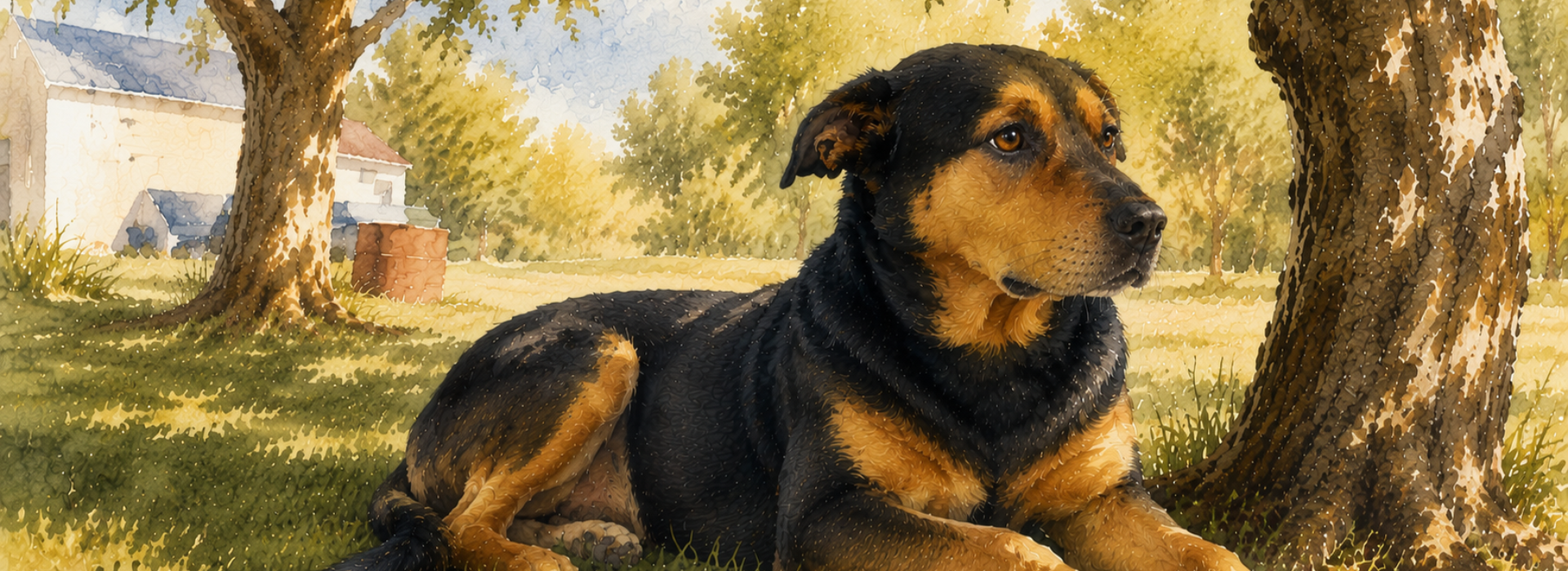
I still look for my dog, Ruger, beneath the fruit trees in my yard.
It isn’t something I mean to do. My eyes just drift there when I’m outside. He spent his final days lying in the shade while we worked on the garden, too tired to chase chickens or wander into neighbouring yards, but still wanting to be where we were.
He should be there.
June was the month we lost him. It was also the month I learned something so simple that I’m almost embarrassed it took me forty years to understand:
I have free will.
Not in some grand, philosophical sense. I mean in the ordinary way.
I can decide that today is the day we get chickens.
I can clear a patch of lawn and turn it into a garden.
I can plant strawberries, even if I don’t know exactly what I’m doing.
I can clean one corner of my house and make tomorrow a little easier for myself.
For most of my life, I think I was waiting for the feeling that I was ready. I assumed that meaningful living would begin after there was more money, less stress, and fewer unfinished projects. I thought passion and purpose belonged to work because work was the only place where I consistently gave myself permission to build, create, and solve problems.
The rest of my life was always waiting for a better season.
June made me wonder if that season ever comes on its own.
The question stayed with me for days.
What was I actually waiting for?
The strange thing is that I never felt this way in my work. If I needed to learn something, I learned it. If there was a problem, I figured it out. I trusted that I was capable of building something worthwhile, even if I didn’t know exactly what I was doing when I started.
Somewhere along the way, I had stopped extending that same trust to the rest of my life.
The realization didn’t come through some dramatic moment or profound conversation.
It came through chickens.
What surprised me most wasn’t that we ended up with chickens. It was how ordinary the whole thing felt.
I bought cheap hinges from the dollar store to fix the door, the girls helped clear the weeds, and we used grass clippings because that was what we had. By the end of the day, the coop was ready, and there were six hens in the yard.
I remember thinking, That was it? I can do this.
For years, I had quietly sorted life into categories. There were things I trusted myself to do, and things I assumed belonged to people who were more capable than I was.
Work always fell into the first category. I knew how to learn, solve problems, and build something meaningful because I had spent years doing exactly that. People noticed. They appreciated the effort. The more I succeeded, the more confidence I gained.
The rest of life never felt quite the same.
I never thought of myself as a dog person. I wasn’t convinced I could grow things or keep a beautiful home. I often felt underqualified in the very areas that mattered most to me—raising children, caring for animals, creating a life that felt peaceful and abundant.
Maybe none of that was ever true. Maybe it was simply a story I had repeated for so long that I stopped questioning it.
The chickens made me pause.
Not because I suddenly became an expert, but because the barrier I had imagined turned out to be remarkably small. I wanted something, I found a way to make it happen, and by the end of the day it existed.
The capability had not arrived first.
The decision had.
The garden came next.
We had talked about having one for years. Every spring, it seemed to belong to some future version of ourselves—one with more money, more time, or a better plan.
This year, I stopped waiting.
I asked where we should put it, measured the space, and started removing the sod. The work took longer than I expected, and I needed help along the way, but that no longer felt like failure. Taking the lead didn’t mean doing everything myself. It meant deciding that this was the year we were finally going to begin.
The strawberries found their way into the garden much the same way. I bought a few bare-root plants from a woman online with money my grandmother had given me, and they sent me home with far more than I expected. I wrapped them in damp paper towel, bought a bag of soil, and planted them as carefully as I knew how.
A few weeks later, there were blossoms.
Now there are tiny strawberries.
I think that’s why I love gardening. It’s the same reason I love baking and drawing.
The small actions become something you can hold in your hands.
You don’t have to be perfect. You don’t have to know everything when you begin. You simply keep showing up, and eventually there is something to show for it. A loaf of bread comes out of the oven. A sketch becomes a finished piece. Tiny green berries appear where there were once only bare roots.
There is something comforting about that.
It reminds me that small things add up, even when we can’t see the progress from one day to the next.
Looking back now, I think what changed this month wasn’t my circumstances as much as my perspective.
I used to think I was waiting for more money, more energy, or better discipline. I told myself that life would feel meaningful when I finally had everything under control.
The truth is, I was waiting to believe that I was capable.
I was waiting for confidence to arrive before I started.
Instead, I found confidence on the other side of action.
I still miss Ruger every day. I wish he were lying beneath the fruit trees, watching the girls collect eggs and the garden slowly fill in around him.
But I think one of the gifts he left me was a new appreciation for the time we do have and the choices that are still ours to make.
Life doesn’t begin when everything is perfect.
Sometimes it begins with a bag of feed, a handful of strawberry roots, and the quiet realization that you can simply decide to start.
So I’ll leave you with the question that has followed me all month:
What are you waiting for?
About The Note
Thoughts, stories, and small observations from our ordinary life in rural Nova Scotia.

Categories
Field Notes
Garden Journal
Recipes
Art & Nature
The Post Subscription
Let's Stay In Touch
Thoughtful letters, seasonal recipes, artwork, and stories from ordinary life.
Thank you!
You have successfully joined our subscriber list.